
System Transition Elements - a model of models

The Waters of Systems Change framework, published by FSG in 2018, has become a widely used lens for designing and assessing system change. Its six conditions — policies, practices, resource flows, relationships and connections, power dynamics, and mental models — are intuitive and accessible. They have helped practitioners across sectors locate where change needs to happen.
In my work across more than a decade of work in system transition in regional economic development, vocational education, resource management, health and safety, manufacturing, construction, primary exporting, health and tourism, the original six conditions have proven useful but incomplete to me.
Four elements consistently appear in real transitions that are not represented in the Waters framework: technologies, innovation, narratives and discourse, and the work of a coordinating transition backbone.
Technologies (both digital and analogue) in sectors undergoing real transition are not merely tools used within practices; they are a distinct site of structural change.
The Waters framework treats innovation implicitly and most would think of it narrowly. In practice, innovation cuts across structural, relational and cognitive layers and needs to be designed for explicitly.
Narratives and discourse are are collective and cultural. Mental models arise from these.
The Collective Impact literature has been clear for more than a decade that breakthrough system innovation requires a coordinating backbone.
I propose a new System Transition Elements model — ten elements arranged across three layers of change (structural, relational and cognitive), with three cross-cutting elements including a coordinating backbone.
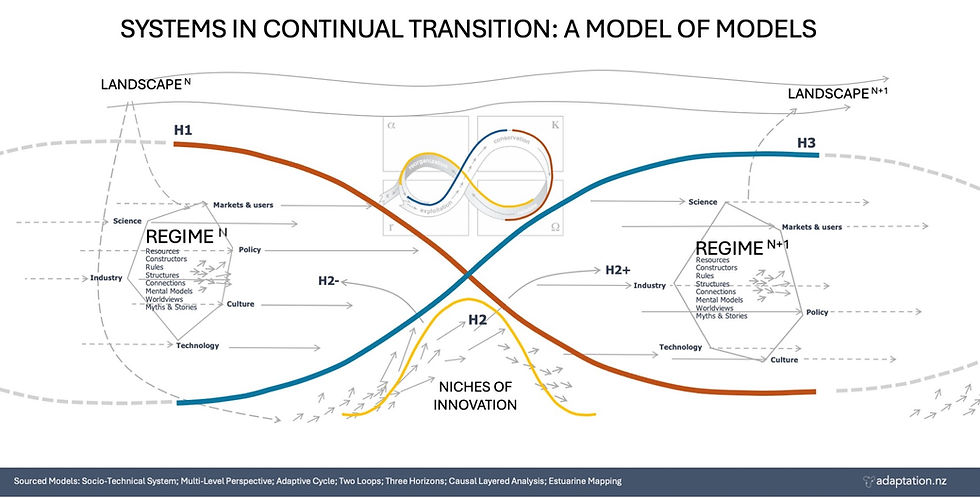
The model is a synthesis. It draws on the Waters of Systems Change, the Multi-Level Perspective, socio-technical systems theory, Causal Layered Analysis, Collective Impact, and the my own work around Transition Trigger Domains.
The model is intended as a pragmatic reference frame for discovery, design and execution in both organisational strategy and sector planning work. It is offered to practitioners who already know one or more of the source models and want a more complete map of where to look, where to intervene, and where to build coordinating capacity.


Comments